

- Understanding C-Stand Architecture and Design Philosophy
- The Distinctive Leg Configuration
- Conventional Light Stand Characteristics
- Professional-Grade C-Stand Solutions for Demanding Applications
- Weight Capacity Considerations and Load Distribution
- Counterweight Strategies
- Comparative Analysis: Mobility Versus Stability
- Application-Specific Recommendations for Different Scenarios
- Event and Performance Lighting
- Accessory Ecosystem and Expansion Possibilities
- Investment Calculus and Long-Term Value Proposition
- Maintenance Requirements and Operational Longevity
- Making the Definitive Equipment Decision
Lighting stands represent the unsung backbone of professional photography and videography setups. While regular light stands have served creators adequately for decades, C-stands have emerged as the professional's choice for demanding production environments. Understanding the distinctions between these two foundational pieces of grip equipment can dramatically elevate your shooting capabilities and determine whether your lighting apparatus remains stable during critical moments.
The choice between a C-stand and a conventional light stand extends beyond mere preference—it fundamentally affects your workflow efficiency, equipment safety, and creative possibilities. For photographers, videographers, DJs, and musicians setting up complex lighting scenarios, this decision impacts everything from setup time to the versatility of modifier placement.
Understanding C-Stand Architecture and Design Philosophy
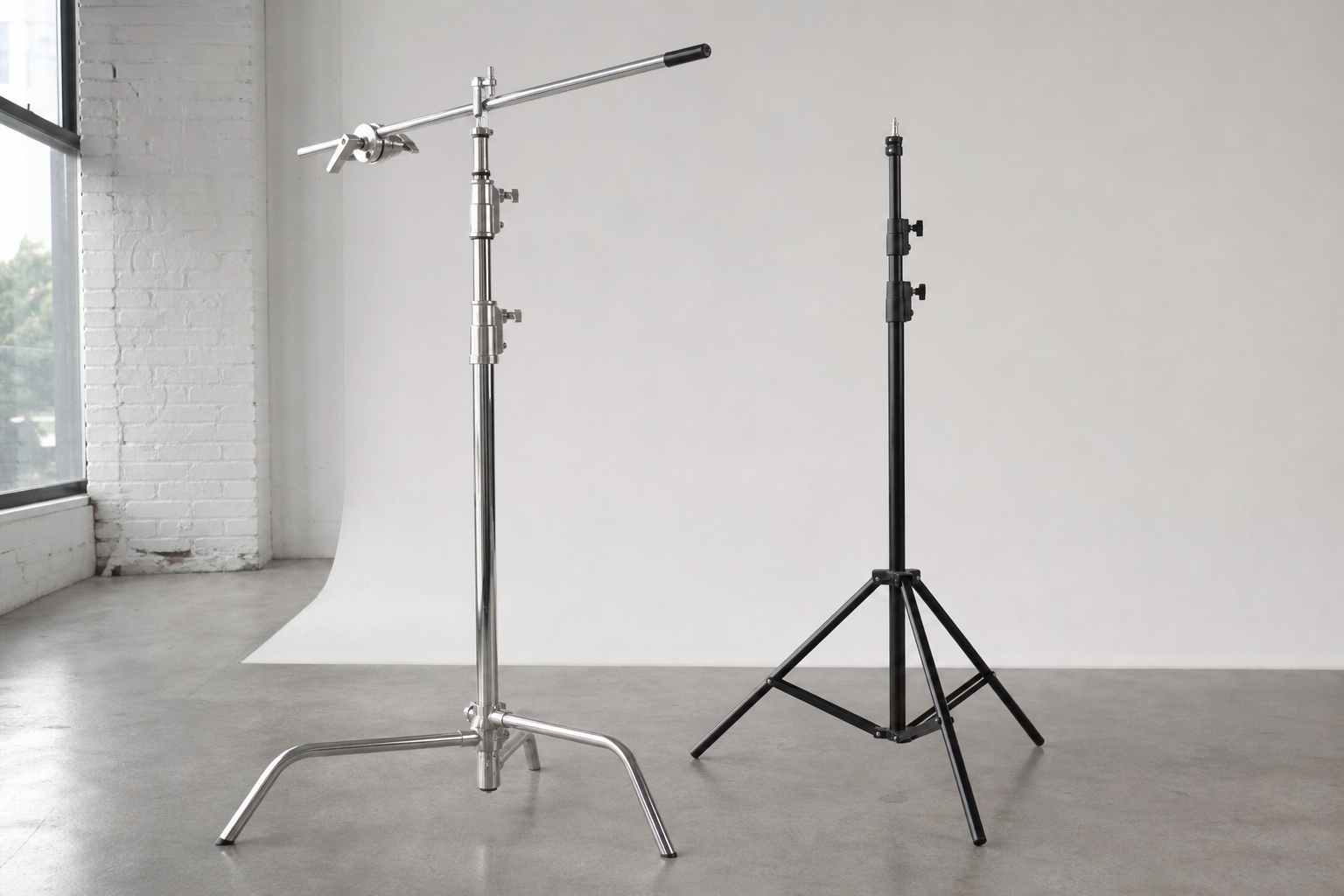
C-stands, formally designated as "Century Stands," derive their nomenclature from the century-old grip equipment manufacturing practices that birthed them. These robust fixtures feature a distinctive tripod base configuration with one leg permanently extended outward—a design choice rooted in practical stagecraft wisdom. This asymmetrical leg positioning allows multiple C-stands to nest together without base interference, maximizing floor space utilization in cramped studio environments.
The construction methodology emphasizes durability through steel tube composition rather than the aluminum alloys common in standard supports. This metallurgical choice imparts substantial heft, creating a lower center of gravity that resists toppling when supporting heavy modifiers or extended boom arms. The signature gobo head and grip arm assembly transforms the C-stand from a mere vertical support into a three-dimensional positioning system capable of articulating lights, flags, reflectors, and countless other production accessories.
The Distinctive Leg Configuration
That peculiar leg arrangement serves a purpose beyond aesthetics. The extended leg should always orient toward the load direction, creating a counterbalance effect that defies intuitive expectations. This configuration principle becomes second nature to seasoned gaffers but initially confounds novice operators accustomed to symmetrical tripod thinking.
Conventional Light Stand Characteristics
Regular light stands epitomize utilitarian simplicity—telescoping aluminum tubes supported by three equidistant legs that fold into compact transport configurations. These workhorses of location photography prioritize portability and rapid deployment over ultimate stability. Spring-loaded locking mechanisms enable swift height adjustments without tools, though this convenience sometimes introduces incremental settling during extended sessions.
The standard light stand excels in straightforward applications: elevating speedlights, supporting small continuous lights, and positioning compact LED panels. Their featherweight construction facilitates solo shooter workflows where every ounce matters during mile-long treks to scenic overlooks. However, this reduced mass becomes a liability when wind gusts threaten or when mounting weighty softboxes with substantial sail area.
Professional-Grade C-Stand Solutions for Demanding Applications
When production requirements escalate beyond basic light positioning, professional-grade C-stands become indispensable. The Hridz 3.3m Heavy Duty C-Stand with 128cm Support Boom Arm & 2 Grip Heads Kit exemplifies the caliber of equipment serious creators require. This comprehensive kit addresses multiple production challenges simultaneously—the impressive 3.3-meter maximum height accommodates overhead lighting scenarios, while the 128cm boom arm extends your reach for hair lights, accent positioning, or flag placement without introducing additional floor clutter.
The inclusion of two grip heads within this package eliminates the frustration of incompatible accessories, ensuring immediate deployment straight from the packaging. For photographers establishing permanent studio spaces or videographers managing multi-camera productions, this level of engineering precision translates to predictable performance under stress. The robust construction methodology withstands the rigors of repeated setup and breakdown cycles that inevitably accompany professional work.
This particular configuration proves especially valuable for musicians and DJs requiring elevated accent lighting that clears crowded stages while maintaining absolute stability amid performance vibrations. The boom arm functionality permits lighting positioning that would require multiple standard stands and precarious extension techniques.
Weight Capacity Considerations and Load Distribution
Load-bearing capacity distinguishes professional from amateur equipment more than any other specification. Standard light stands typically max out between 5-10 pounds before stability concerns emerge, particularly when extended to maximum height. C-stands routinely support 20-50 pounds depending on configuration, with premium models handling even greater loads when properly counterweighted.
The physics involved extend beyond simple weight ratings. Moment arm calculations—the product of load mass and distance from the vertical support axis—determine actual topple risk. A lightweight modifier positioned far from center on an extended boom creates more overturning force than a heavier light mounted close to the vertical tube.
Counterweight Strategies
C-stands accommodate sandbag placement on that extended leg specifically designed to offset eccentric loads. This counterbalancing provision remains absent from conventional light stands, which rely solely on base spread and inherent mass for stability. Savvy operators exploit this feature to create seemingly gravity-defying equipment arrangements.
Comparative Analysis: Mobility Versus Stability
| Characteristic | C-Stand | Regular Light Stand |
|---|---|---|
| Weight | 10-15 lbs | 2-5 lbs |
| Load Capacity | 20-50 lbs | 5-10 lbs |
| Setup Time | Moderate | Fast |
| Boom Arm Capability | Standard Feature | Rarely Available |
| Price Point | $80-$300+ | $20-$80 |
The data illuminates fundamental trade-offs inherent to equipment selection. Transportation logistics favor lighter alternatives, yet on-set stability demands mass and engineering sophistication. Budget constraints influence initial purchasing decisions, though equipment failures during paid sessions impose costs far exceeding the price differential between quality tiers.
Application-Specific Recommendations for Different Scenarios
Location portraiture favors conventional stands—their compact fold and minimal weight facilitate public space navigation and rapid repositioning for dynamic outdoor sessions. Environmental conditions permitting, a quality standard stand suffices for battery-powered speedlight work or compact LED panels.
Studio operations flip this calculus entirely. Permanent installations benefit from C-stand investment where transportation concerns vanish and stability becomes paramount. Videographers maintaining consistent lighting setups across multiple recording sessions appreciate the positional repeatability C-stands provide through their locking mechanisms and substantial mass.
Event and Performance Lighting
DJs and musicians confronting crowded venues with foot traffic hazards require the insurance C-stands provide. Stage environments introduce vibration, inadvertent contact, and cable management challenges that lightweight stands simply cannot address. The ability to position lights overhead via boom arms keeps equipment beyond accidental interference zones while maintaining precise aiming.
Accessory Ecosystem and Expansion Possibilities
The grip hardware universe revolves around standardized connections that C-stands exploit fully. Gobo heads accept countless attachments beyond lighting instruments:
- Flags and scrims for precise light shaping
- Reflector arms positioning fill cards at optimal angles
- Audio equipment mounts for overhead microphone placement
- Backdrop support systems eliminating dedicated crossbar stands
- Product photography sweep holders maintaining seamless backgrounds
This modularity transforms a single C-stand into a multi-functional production tool that adapts to evolving creative requirements. Standard light stands, constrained by their basic tilt head or spigot mounting, offer minimal expansion pathways.
Investment Calculus and Long-Term Value Proposition
The acquisition cost differential between equipment categories initially deters budget-conscious creators. A professional C-stand kit commands 3-5 times the investment of a basic light stand. However, depreciation curves tell a different story—quality grip equipment maintains functionality across decades while budget stands exhibit flex, stripped threads, and collapsed lock mechanisms after minimal use.
Equipment reliability directly correlates with professional reputation. A collapsing light stand during a client session costs more in lost trust than years of incremental savings from budget purchases.
For creators transitioning from hobbyist to professional status, strategic equipment acquisition matters. Starting with one exceptional C-stand supplemented by standard supports for auxiliary lights establishes capability growth without paralyzing initial capital requirements.
Maintenance Requirements and Operational Longevity
Steel construction demands minimal maintenance beyond periodic lubrication of sliding tubes and tightening of occasional loosened bolts. C-stands tolerate abuse that would permanently damage aluminum alternatives—dents rarely affect functionality, and replacement parts remain available for decades-old models.
Regular light stands require gentler handling. Overtightening locking collars strips threads; extending sections beyond marked limits stresses joints; aluminum fatigue eventually manifests as catastrophic failures at inopportune moments. These limitations don't preclude their use but demand awareness regarding operational lifespan expectations.
Making the Definitive Equipment Decision
Neither option universally supersedes the other—context determines appropriateness. Evaluate your primary working environment, typical equipment loads, transportation constraints, and budget realities. Photographers emphasizing mobility and working solo with compact lighting benefit from standard stand collections. Videographers establishing studio infrastructure or managing team-based productions require C-stand foundation investments.
The hybrid approach maximizes versatility: acquire premium C-stands for primary lighting instruments and heavy modifiers while maintaining standard stands for auxiliary lights, background illumination, and location work. This diversified inventory accommodates evolving project requirements without redundant capability or inadequate equipment availability.
Quality matters regardless of category selection. Equipment from reputable manufacturers like those available through Hridz.com.au ensures compliance with load ratings, predictable performance characteristics, and adequate customer support. Their curated selection of photography, videography, and audio equipment reflects understanding of professional requirements across creative disciplines—from camera batteries sustaining extended sessions to XLR cables maintaining signal integrity in complex audio installations.
Ultimately, lighting support equipment fades into invisibility when properly selected and deployed. Your audience never contemplates the stands securing your meticulously positioned lights—they simply experience the visual results. Investing in appropriate grip equipment eliminates distractions, enhances safety, and liberates creative focus toward what truly matters: capturing compelling imagery that resonates with viewers.




Share:
Photography Lighting Basics: Master Natural and Artificial Light
Best Photography Backdrops for Product & Portrait Photography