

- Understanding the Fundamental Differences
- Acoustic Isolation Properties
- Driver Technology and Frequency Response
- Professional Audio Requirements for Musicians
- Critical Listening Applications
- EDX Pro In-Ear Monitors: Professional-Grade Solution
- Sound Quality and Technical Performance
- Frequency Response Characteristics
- Dynamic Range and Sensitivity
- Comfort and Fit Considerations
- Fit Customization Options
- Durability and Build Quality
- Environmental Resistance
- Cost Analysis and Value Proposition
Understanding the Fundamental Differences
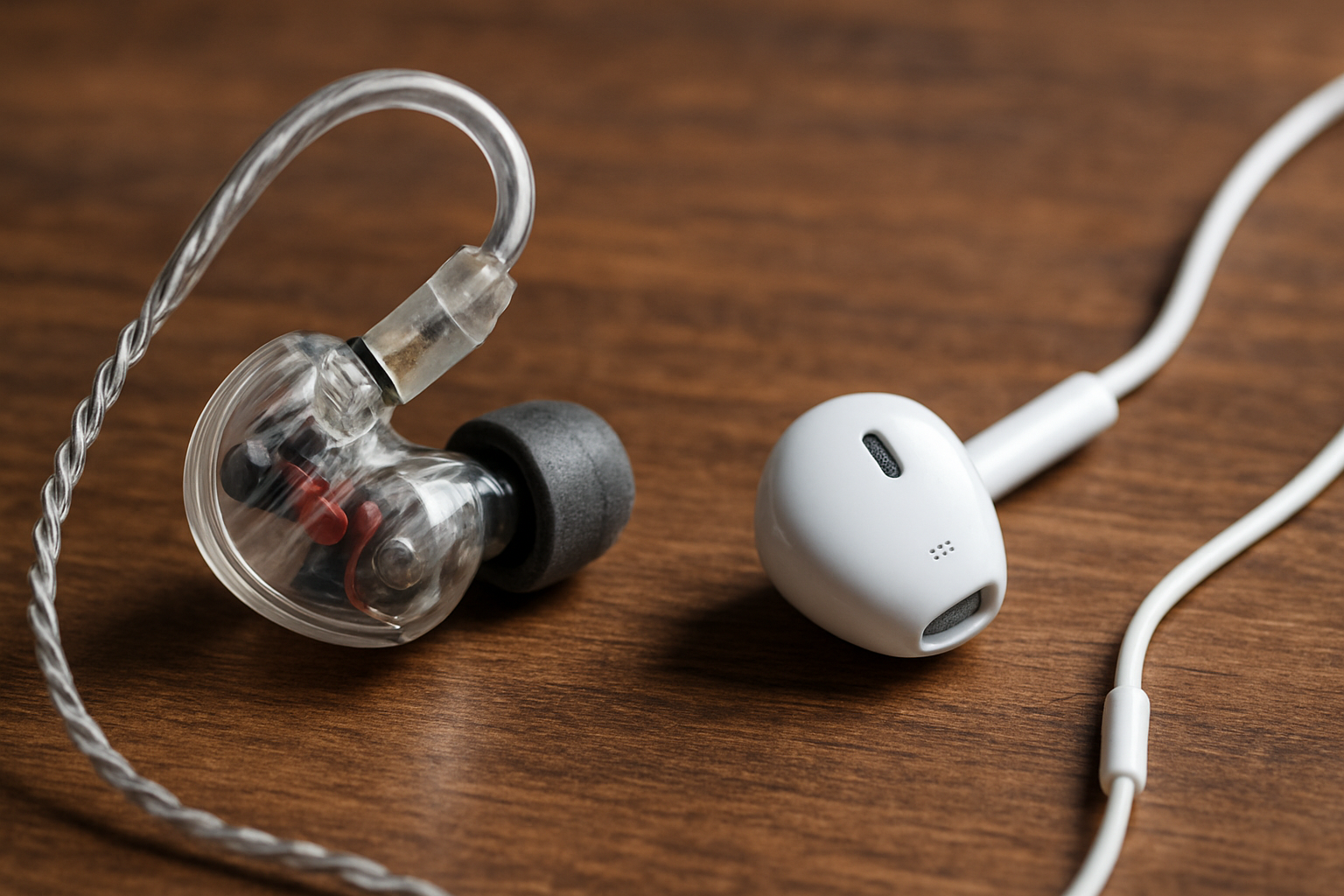
In-ear monitors (IEMs) and standard earbuds represent two distinct paradigms in personal audio reproduction, each engineered with markedly different acoustic philosophies. Musicians require precise audio reproduction for both performance and practice scenarios, making this choice particularly consequential for their craft.
Standard earbuds typically rest within the outer ear's concha, creating a loose seal that allows ambient noise infiltration. This design philosophy prioritizes comfort for casual listening but compromises isolation capabilities. Conversely, IEMs utilize custom or universal silicone tips that penetrate deeper into the ear canal, establishing hermetic seals that dramatically attenuate external interference.
The transduction mechanisms also differ substantially. Most consumer earbuds employ dynamic drivers optimized for broad frequency response rather than critical monitoring applications. Professional IEMs often incorporate balanced armature drivers, planar magnetic elements, or hybrid configurations specifically calibrated for neutral, reference-quality reproduction.
Acoustic Isolation Properties
Passive noise isolation represents perhaps the most significant differentiator between these technologies. IEMs can achieve 15-30 dB of ambient noise reduction through their deep insertion design and premium tip materials. This isolation proves invaluable during live performances where stage volume can exceed 100 dB SPL.
Standard earbuds offer minimal isolation, typically reducing ambient noise by merely 3-8 dB. While this allows situational awareness, it necessitates higher listening volumes to overcome environmental interference, potentially contributing to long-term hearing damage.
Driver Technology and Frequency Response
Professional IEMs frequently utilize multiple driver configurations to optimize frequency reproduction across the entire audible spectrum. Balanced armature drivers excel at reproducing midrange and treble frequencies with exceptional clarity, while dedicated subwoofers handle low-frequency reproduction. This compartmentalization enables precise crossover tuning and reduced intermodulation distortion.
Consumer earbuds predominantly rely on single dynamic drivers that must reproduce the entire frequency range simultaneously. While modern dynamic drivers have improved considerably, they cannot match the precision and separation achievable through multi-driver IEM configurations.
Professional Audio Requirements for Musicians
Musicians demand uncompromising accuracy from their monitoring systems to make critical mix decisions and performance adjustments. The ability to discern subtle timbral variations, spatial positioning, and dynamic nuances directly impacts creative outcomes and professional competency.
During live performances, musicians rely on in-ear monitoring systems to hear themselves and other band members clearly above ambient stage noise. This requirement extends beyond simple volume considerations to encompass phase coherence, transient response, and frequency balance that enables precise pitch and timing accuracy.
Critical Listening Applications
Studio monitoring scenarios require exceptionally flat frequency response curves and minimal coloration. Musicians must identify problematic frequencies, assess stereo imaging, and evaluate mix translation across various playback systems. IEMs designed for professional applications typically exhibit ±2 dB frequency response tolerances, while consumer earbuds may deviate by 10 dB or more across critical frequency bands.
The impedance characteristics also influence professional suitability. Many IEMs feature low impedance ratings (16-32 ohms) optimized for wireless bodypack systems common in live performance environments, whereas standard earbuds may present impedance mismatches that compromise dynamic range and signal integrity.
EDX Pro In-Ear Monitors: Professional-Grade Solution
For musicians seeking reference-quality monitoring without compromising portability, the EDX Pro In-Ear Monitors offer exceptional value proposition. These wired earphones feature HiFi stereo reproduction with enhanced bass response, specifically engineered for professional audio applications.
The EDX Pro addresses common musician challenges through its ergonomic design and superior isolation properties. Multiple silicone tip sizes ensure optimal fit across diverse ear canal geometries, while the robust cable construction withstands the rigorous demands of live performance environments.
These monitors excel in both studio and stage applications, delivering the accuracy musicians require for critical listening tasks while maintaining the comfort necessary for extended monitoring sessions.
Sound Quality and Technical Performance
Objective measurements reveal substantial performance disparities between professional IEMs and consumer earbuds across multiple acoustic parameters. Total harmonic distortion (THD) levels in quality IEMs typically remain below 0.5% across the audible spectrum, while standard earbuds may exhibit distortion exceeding 3% at moderate listening levels.
Intermodulation distortion presents another critical consideration for musicians working with complex harmonic content. The crossover-optimized driver configurations in multi-way IEMs minimize interference between frequency bands, preserving the integrity of polyphonic musical passages.
Frequency Response Characteristics
Professional monitoring applications demand extended frequency response spanning the complete audible spectrum (20 Hz - 20 kHz) with minimal deviation from neutral reproduction. High-quality IEMs achieve this through careful acoustic tuning and premium driver selection.
"The difference between hearing your mix accurately and hearing what you think sounds good can make or break a professional recording. Accurate monitoring is non-negotiable in serious music production." - Audio Engineering Principle
Standard earbuds frequently exhibit pronounced bass emphasis and elevated treble response designed to enhance perceived excitement rather than accuracy. This "V-shaped" tuning philosophy proves counterproductive for professional monitoring applications where neutral reproduction remains paramount.
Dynamic Range and Sensitivity
The dynamic range capabilities of IEMs typically exceed consumer earbuds by significant margins. Professional monitors must reproduce everything from delicate pianissimo passages to fortissimo climaxes without compression or clipping artifacts that could mask important musical details.
Sensitivity specifications also influence practical usability. IEMs designed for professional applications balance high sensitivity for compatibility with low-power wireless systems against noise floor considerations that could introduce unwanted hiss or interference.
Comfort and Fit Considerations
Extended wear comfort becomes critical for musicians during lengthy recording sessions, rehearsals, or performances. The deeper insertion required for IEMs initially feels more intrusive than standard earbuds, but properly fitted monitors distribute pressure more evenly across the ear canal walls.
Ergonomic design variations accommodate different ear anatomies through multiple tip styles and sizes. Memory foam tips provide superior isolation and comfort but require replacement more frequently than silicone alternatives. Triple-flange tips maximize isolation but may prove uncomfortable during extended use.
Fit Customization Options
Universal-fit IEMs offer practical compromises between custom performance and economic accessibility. The inclusion of multiple tip options enables users to optimize both comfort and acoustic performance without the expense and time commitment required for custom-molded alternatives.
Custom IEMs represent the ultimate in personalized fit and isolation but require professional ear impressions and extended manufacturing lead times. For many musicians, universal-fit monitors with premium tips provide 90% of custom performance at significantly reduced cost and complexity.
Durability and Build Quality
Professional musicians subject their equipment to demanding environments that quickly reveal design weaknesses. IEMs intended for professional use incorporate reinforced cable connections, strain relief systems, and corrosion-resistant materials capable of withstanding touring rigors.
| Component | Professional IEMs | Standard Earbuds |
|---|---|---|
| Cable Construction | Oxygen-free copper, reinforced strain relief | Standard copper, basic strain relief |
| Driver Protection | Moisture barriers, wax guards | Basic mesh screens |
| Connector Quality | Gold-plated, locking mechanisms | Nickel-plated, friction fit |
Environmental Resistance
Stage environments expose audio equipment to temperature extremes, humidity variations, and physical stress that consumer products rarely encounter. Professional IEMs incorporate moisture-resistant coatings and sealed driver assemblies that prevent performance degradation under adverse conditions.
Replaceable cable systems common in professional IEMs eliminate the most frequent failure point in portable audio equipment. When cables inevitably fail, users can replace them without discarding the expensive driver assemblies.





Share:
iPhone Audio Recording Setup: Essential Adapters & Equipment
Photography Light Filters: Complete Guide to Creative Effects